Vertek's latest news on the use of CPTu test results!
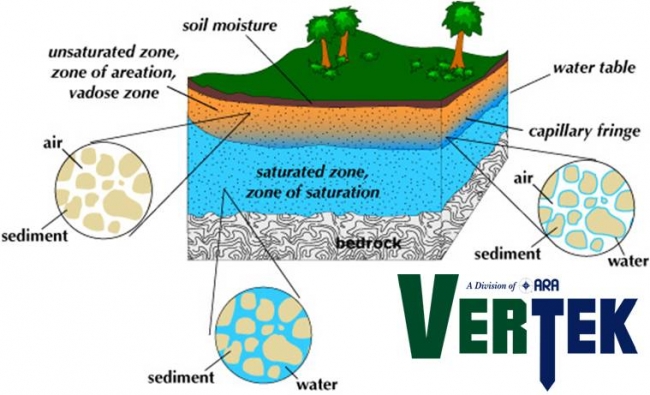
Apart from correcting and adjusting soil behavior type characterizations, pore pressure data can be used in a variety of ways, with the most important being the ability to estimate the groundwater conditions! Read Vertek's latest post for more information!
In practically all projects of site characterization, as well as geo-environmental and remediation applications understanding ground water conditions is a key aspect. Ground water conditions involve estimating the depth of the water table, as well as the direction and rate of groundwater flow and CPTu data can be used towards that direction.
Information can be obtained through multiple CPTu soundings to generate a 3-D model of the subsurface hydrogeologic conditions and specify the necessary parameters, such as direction and velocity of groudwater flow, spatial distribution of hydraulic conductivity etc) to be used for deep foundation design, site investigations and remediation design.
Learn more on the CPTu test and how to handle and interpret the obtained data by reading Vertek's article here!
Source: Vertek
Want to read more like this story?

CPTu: Vertek's news on the value of pore pressure CPT data
Feb, 04, 2015 | NewsUnlike conventional CPT cones, modern devices come with a special pore pressure sensor. Vertek analy...

Vertek CPT: How pore pressure data is used to correct and analyze CPT data?
Feb, 27, 2015 | NewsIn continuation to the previous article provided by Vertek CPT University, pore pressure s...
Site Characterization & In-situ Testing (General)
Apr, 14, 2021 | EducationSite Characterization Site characterization is a systematic study conducted to collect data regar...

GEO5 FEM - Water Flow
Aug, 16, 2019 | Software
How to Perform Dewatering in PLAXIS
Jun, 11, 2021 | NewsThe problem of changing water conditions is omnipresent in geotechnical engineering. Groundwater is...

Leapfrog Works
Dec, 29, 2022 | Software
Eurocode's Ground Model Revolution: A New Era in Geotechnical Engineering
Dec, 25, 2024 | NewsThe Ground Model, as defined by the 2nd generation Eurocode 7, serves as a "site-specific outline o...

Vertek CPT University: Soil profile determination based on CPT data
Jan, 20, 2015 | NewsCone Penetration Testing is a widely used technique for soil profile determination, allowing geotech...
Brownfield success: Engineering excellence starts below ground
May, 06, 2026 | NewsWhy environmental and geotechnical teams must unite data and work as one to better manage risks in b...
On This Day
August 23rd 1842
READ MORE
Related Video

Trending

What controls the height of the world's mountains?

AI-enhanced landslide model ready for 2026 deployment in Hong Kong
Major wastewater tunnel procurement begins in southern Sweden