
Rocscience Inc.'s Technical Workshop: Finite Element Modelling of Underground Excavations begins on Aug 26th 2026
Rocscience Inc.'s Technical Workshop: Finite Element Modelling of Underground Excavations begins on Aug 26th 2026
Create a free account and view content that fits your specific interests in geotechnical engineering Learn More
Eurocode7 GeotechnicalEngineering ConstructionStandards
Simplifying Complexity: Key Innovations in the Updated Eurocode 7

The evolution of construction standards in Europe has reached a pivotal moment with the introduction of the 2nd generation Eurocodes. These revised codes promise to transform geotechnical and structural design by offering more streamlined guidelines, improved reliability, and enhanced usability. Let’s explore what these changes mean for the geotechnical engineering community.
Transforming Geotechnical Design Standards
The 2nd generation Eurocodes aim to enhance clarity and consistency in structural and geotechnical design. For geotechnical engineers, the transformation of Eurocode 7 into three distinct parts is particularly noteworthy:
- General Rules (EN 1997-1) - Sets the groundwork for safe and serviceable designs.
- Ground Properties (EN 1997-2) - Focuses on accurate characterization of ground conditions.
- Geotechnical Structures (EN 1997-3) - Addresses the design of specific geotechnical structures like retaining walls and reinforced slopes.
One significant improvement is the removal of the previous "Design Approaches" system, simplifying how partial factors are applied. Engineers can now choose between the Material Factor Approach (MFA) or the Resistance Factor Approach (RFA), depending on project requirements. This flexibility, paired with clearer guidelines on groundwater conditions and structural reliability, ensures more accurate and efficient geotechnical designs.
Key Innovations and Risk Management
The new codes emphasize integrating risk management throughout the design process. By linking consequences of failure with ground complexity, engineers are better equipped to make informed decisions tailored to each project. Geotechnical categories now play a more significant role in driving these decisions, balancing safety, performance, and economic feasibility.
Technical innovations include:
- Improved Verification Methods: Enhanced methods to verify ultimate limit states based on simplified loading conditions.
- Groundwater Analysis: More precise guidelines on managing groundwater pressures, vital for safe foundation and retaining wall designs.
- Ground Models: Explicit inclusion of ground models as a core tool for assessing site-specific conditions.
A Framework for the Future
Set to be implemented in the mid-2020s, the 2nd generation Eurocodes will serve as a robust framework for designing safe, durable, and efficient structures across Europe. Beyond improving design quality, these changes align with global demands for sustainable construction practices, contributing to a greener future.
Geotechnical engineers, educators, and software developers should begin familiarizing themselves with these codes to ensure a seamless transition. As these standards roll out, they promise to elevate the quality and reliability of geotechnical engineering for decades to come.
Sources: geocentrix.co.uk, eurocodes.jrc.ec.europa.eu
Want to read more like this story?

Designing for Safety and Sustainability: How Eurocode 7 Second Generation Shapes Retaining Structures
Jan, 26, 2025 | NewsThe second generation of Eurocode 7 introduces a pivotal evolution in the geotechnical design of re...
Other Geotechnical
Jun, 04, 2019 | Education

Eurocode 7's Evolution: Enhancing Resilience with Reliability Based Methods in Geotechnical Projects
Jan, 16, 2025 | NewsThe second-generation Eurocode 7 marks a pivotal evolution in geotechnical engineering standards, i...

Eurocode's Ground Model Revolution: A New Era in Geotechnical Engineering
Dec, 25, 2024 | NewsThe Ground Model, as defined by the 2nd generation Eurocode 7, serves as a "site-specific outline o...
Considerations and Applications of FEA
Oct, 13, 2025 | EducationSetting up an FE model in geotechnical engineering is a process that requires careful consideration...

BETONexpress
Oct, 15, 2013 | Software
Coffee Corner: Geotechnical Analysis - Engineering Monopiles: Smarter design with PLAXIS Monopile Designer
Jul, 23, 2025 | EventPLAXIS 3D, combined with PLAXIS Monopile Designer, empowers engineers to model complex soil-structu...

Enable true ground-informed design in Civil 3D
Jul, 02, 2026 | NewsOur understanding of ground conditions evolves with the project, so geotechnical design teams need a...
Geotechnical Earthquake Engineering
Apr, 21, 2020 | Education
On This Day
August 22nd 1891
READ MORE
Related Video

Trending

May, 15, 2024 | News
Lake Chippewa’s floating island that has to be boat-pushed every year
Jun, 17, 2021 | News
How to Model Piles in PLAXIS

Feb, 12, 2025 | News
3 Types of Retaining Walls and Revetments


May, 25, 2015 | News
How Do Dams Trigger Earthquakes?
May, 26, 2026 | News
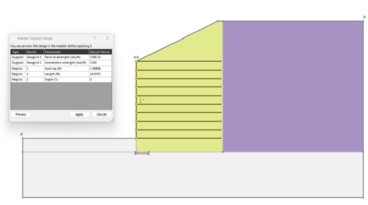
Stop Guessing, Start Designing: Introducing Support Designer in Slide2
May, 26, 2026 | News
Development program prepares new engineers for success
Apr, 29, 2026 | News