The latest PLAXIS release features a new database for calculation inputs and results. This upgrade offers faster output, improved data accessibility, and more consistent results, enabling users to push modelling boundaries.
New calculation input and results database
The application’s calculation input and calculated results as well as its storage have been redesigned, resulting in many improvements and better consistency of the PLAXIS data. Changes span across calculation input, results calculation, results derivation, curve performance and results availability. With the new storage format, extra but well-structured data is written before and during the calculation. This extra and well-structured data can have a small cost in terms of calculation performance compared to the old data storage model, which also varies depending on the complexity and size of the project and the type of calculation and number of steps, etc. The slight increase in calculation time is offset by the improved performance in the Output program, particularly in curve generation, phase switching and result type transitions.
Notable changes and improvements that have been introduced are:
- Improved extrapolation of results from stress points to the nodes, especially for 15-noded triangular elements in PLAXIS 2D.
- Some coupled and flow calculation results that are natively computed on the nodes are not extrapolated from the stress points anymore.
- Result types that do not exist for certain calculation types or pore pressure calculation combinations etc., are now shown as Not Available instead of zero.
- Improved reliability and inspectability of UDSM results including their state parameters when working with multiple UDSM’s.
- Some calculation pre-processing done by the kernel, regarding connectivity of loads or anchors for phases with different active states of connected soils or structures, is moved to the calculation preview and can now be inspected before calculation.
- For PLAXIS 3D, the fixities, prescribed displacements and loads can now be viewed in the mesh preview of the generated mesh, allowing users to identify the correctness of the generated mesh and spot potential issues with the automatic fixity generation on the boundaries, or other modelling features in an earlier stage. For PLAXIS 2D, these capabilities already existed in earlier releases.
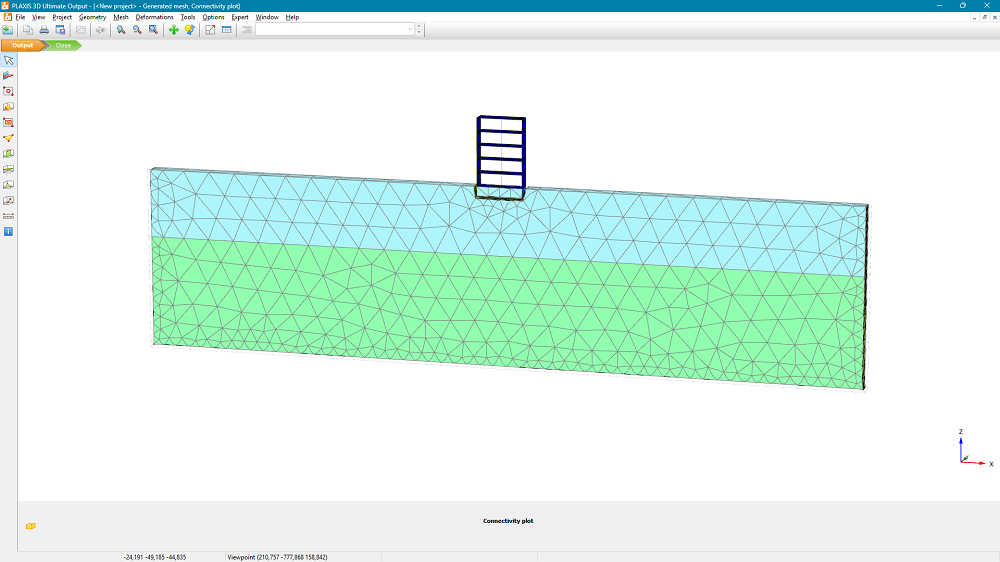
View of the generated mesh from Mesh mode in 2024.3 and earlier
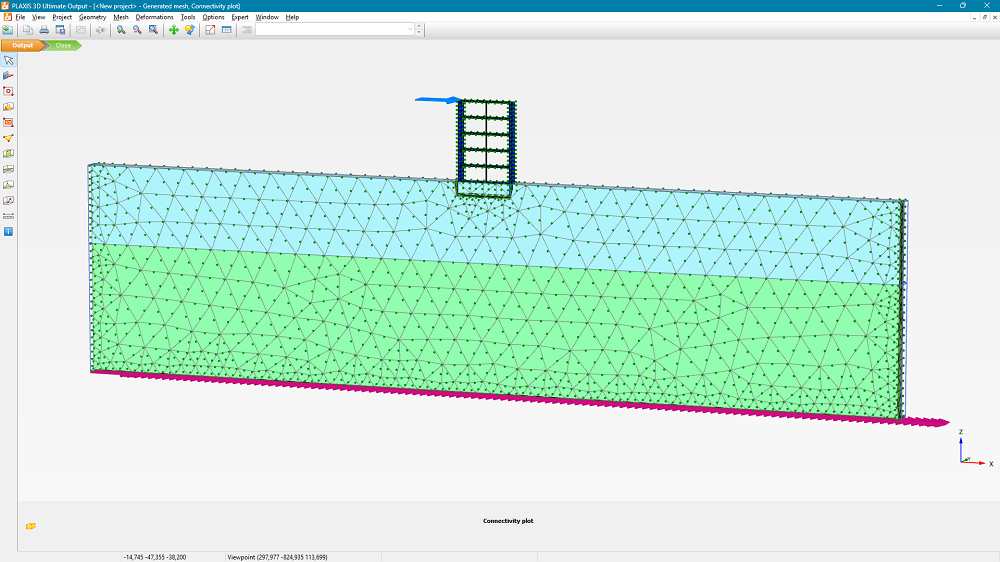
View of the generated mesh from Mesh mode from 2025.1
- Drastically increased performance of pre- and post-calc curve generation, especially noticeable for large PLAXIS projects.
- Curve points no longer plot zeros in curve point plots for phases where the underlying soil or structure of that curve point is deactivated.
- Curve points now include all result types available for specific soil nodes or stress points, like for example native models and UDSM state parameters. Because of these new result types, it’s no longer necessary to save all the intermediate steps for the calculation and then generate these curves by selecting a post-calc curve point. This saves storage space, especially in calculations with lots of steps and the generation of curves is much faster.

Example of NorSand state parameters now tracked for pre-calculation curve points, compared to 2024.3 version
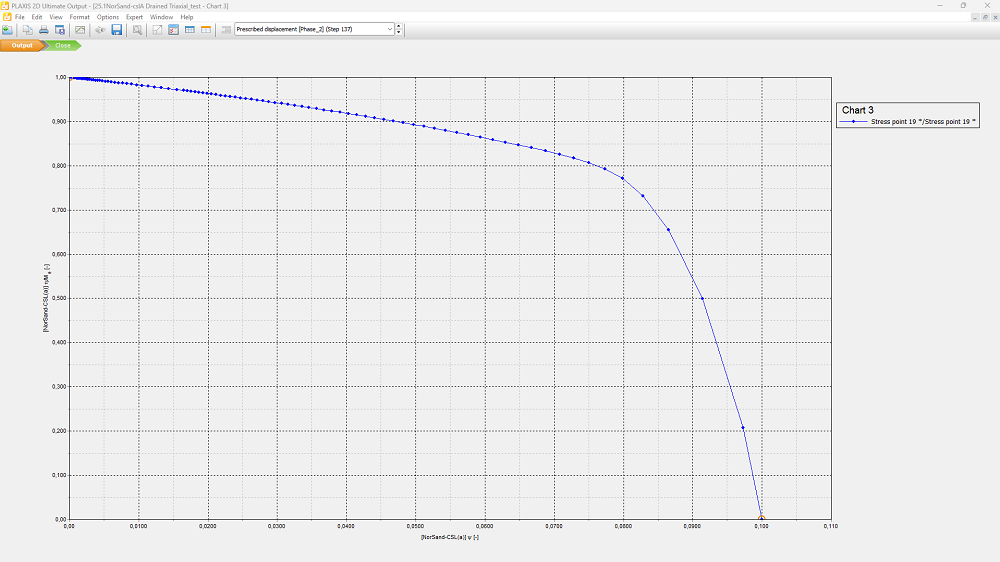
Plot showing the occurrence of failure by flow liquefaction, generated from new curve result types
- When post-calc curve points have been selected on a structure or soil cluster once a calculation was completed, these curve points will be considered pre-calc curve points when the calculation is rerun, storing the curve data during the calculation.
- SOLVED PLAXIS 3D known Issue: Displacement fixities are now correctly applied automatically to isolated beam elements on model boundaries.
Due to this major change, when opening older projects, they will be converted and saved with a _converted suffix in the 2025.1 format and require remeshing and recalculation.
To ease the transition to the new release and not block ongoing projects, side-by-side installation with the previous releases of PLAXIS is supported.
Changes to automatic vertical fixities used in compliant base boundary condition
A fully absorbent compliant base boundary is now available, including along a direction for which no signal is applied.
In the past, a rigid (and, therefore, reflective) condition would be considered for the ‘fixed’ degrees of freedom of the compliant base boundary. For example, if an earthquake signal would be applied only in a given direction with the remaining directions being considered fixed (through a line or surface prescribed displacement), then the compliant base would be only absorbent along the direction of the signal. In this release, the directions along which no signal is applied are also made absorbent by allowing the inner nodes of the boundary to move relative to its outer nodes (at which the user-defined displacement conditions are applied).
The benefit of this choice is the added ability of the boundary to absorb motions created by reflections, typically due to soil-structure interaction or non-horizontal soil layers. Naturally, these reflections have generally much smaller amplitudes than the earthquake-induced motion applied to the model and, therefore, in most practical cases, the users will observe little impact on the obtained results. The drawback of this choice is the fact that displacements will likely occur at the base of the model, given the fact that the inner nodes of the boundaries are now free to move, including for directions along which no signal is applied - a condition necessary for the absorption capability.
Other enhancements, fixes and changes
- Performance of the checkgeometry command has been improved, returning adjacent geometry pairs faster.
- Greatly improved speed of pore pressure calculation for models with user imported phreatic level in phase preparation stages in PLAXIS 3D, especially in case of a fine finite element mesh.
- Added four new state parameter result types for the NorSand model, representing the operating friction ratio, the stress ratio at the current lode angle, the state parameter at the current image stress, and the scaling factor for the operating friction ratio. These help in gaining a better understanding of the model’s behaviour.
- SOLVED Known Issue: Dynamic boundary condition options in PLAXIS projects now show only the allowed options instead of all. PLAXIS 24.3 projects affected by this issue can be opened with PLAXIS 2025.1 to fix it.
- Fixed an issue where in some cases importing CAD files failed due to a third party license error with the DXF importer.
- In PLAXIS 3D 2024.03, using plate elements with the option "prevent punching" activated, would always trigger a failed calculation. This is now resolved.
- Upgraded Python environment to Python 3.12.11 to keep up with the latest security improvements.
- Import PLAXIS LE (Technology preview) feature removed from the PLAXIS 2D software.
PLAXIS Monopile Designer
- PLAXIS Monopile Designer 2025.1 is fully compatible with the new calculation input and results database introduced in PLAXIS 3D 2025.1
- Upgraded Python environment to Python 3.12.11 to keep up with the latest security improvements.
- Fixed an issue where the 1D analysis might not reach the target displacement in very loose sands.
Want to read more like this story?

Bentley releases new PLAXIS versions
Jun, 15, 2020 | NewsBentley is happy to announce the release of new PLAXIS CONNECT version (Edition V20 Update 3), incl...

New releases: PLAXIS CONNECT Edition V22 Update 2 is out!
Oct, 13, 2022 | NewsWith the latest release of PLAXIS 2D, PLAXIS 3D, and PLAXIS Monopile Designer, Bentley continues to...

New release PLAXIS CONNECT Edition V22 Update 1 is out!
May, 19, 2022 | NewsIn this latest minor release for PLAXIS 2D, PLAXIS 3D and Monopile Designer Bentley Systems introdu...

PLAXIS 2024.2 New release is out!
Sep, 04, 2024 | NewsThis latest PLAXIS release includes two new user defined materials models, one that helps improving...

New release of PLAXIS CONNECT Edition V20 Update 1
Jan, 20, 2020 | NewsPLAXIS CONNECT Edition version 20.0 includes streamlined user experience, increased performance an...

PLAXIS 2023.2 New release is out!
Sep, 07, 2023 | NewsThis latest release solidifies Seequent's Connected Geotechnical Workflow, reducing the need for du...

How to Speed Up Calculation Time with PLAXIS
Aug, 24, 2021 | NewsNumerical analysis is a valuable tool to support the decision-making process in geotechnical design...

PLAXIS 2023.1 New release is out!
Mar, 01, 2023 | NewsThe latest releases of PLAXIS marks our definitive transition to becoming part of Seequent, The Ben...

New major release PLAXIS CONNECT Edition V22.00 is out!
Jan, 28, 2022 | NewsPLAXIS V22 brings a major overhaul to the data structure of the material database and a more flexib...
Form
Looking for more information? Fill in the form and we will contact Bentley for you. Alternatively, you can visit Bentley's website and speak with a Bentley Geotechnical Expert.
On This Day
August 21st 1960
READ MORE
Related Video

Trending

Quick Clay Failure on Norway’s E6 at Levanger

Keller North America announces recent leadership changes

Fulgurite: A rare phenomenon
Major wastewater tunnel procurement begins in southern Sweden