
New findings about Martian landslides
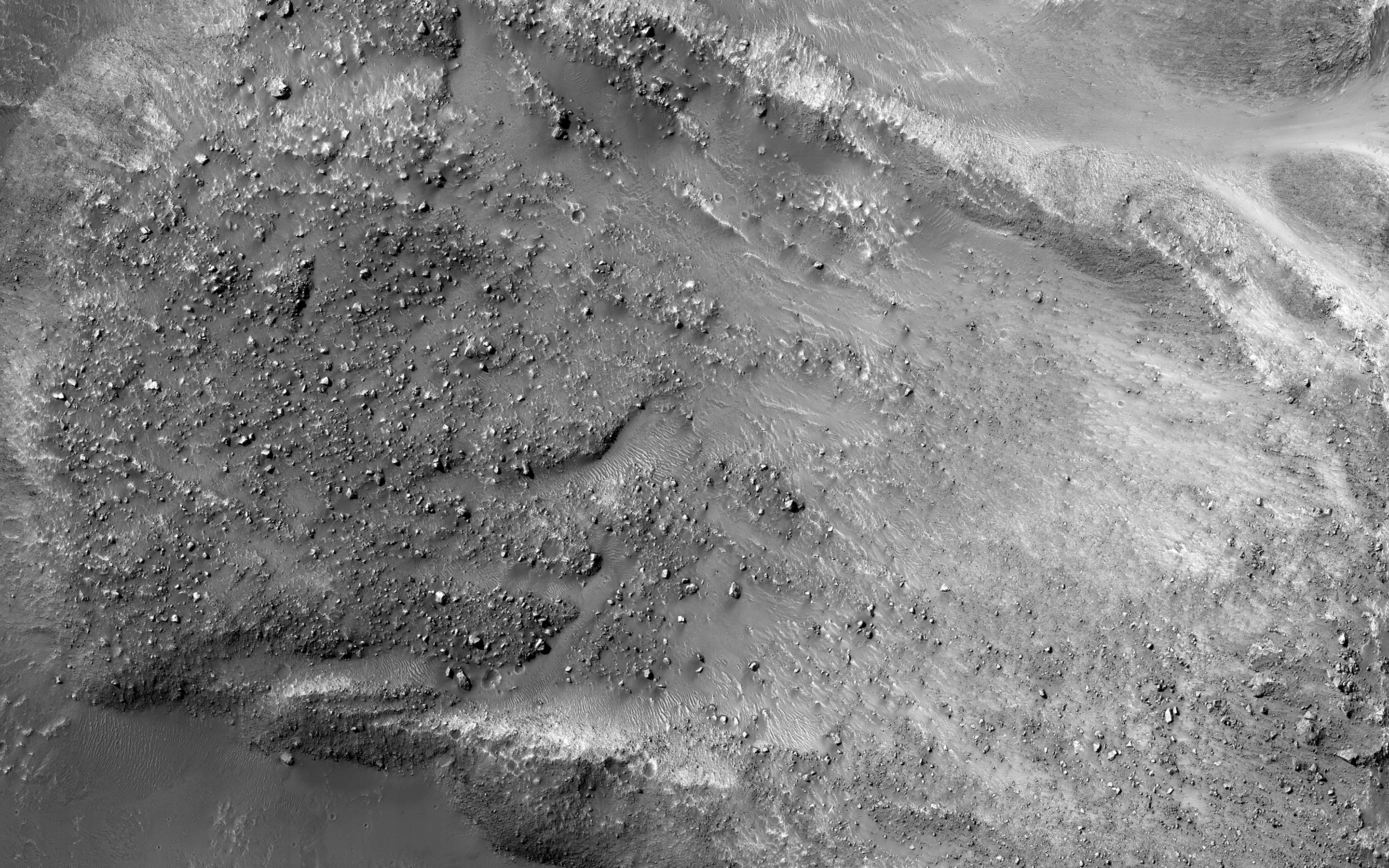
A new study, published in Nature Communications, reveals new evidence about Martian landslides.
The surface of Mars consists of large ridges that were formed 400 million years ago and were a result of intense landsliding of the ground. Until recently, it was considered that those landslides derived from the ground's movements on ice layers. However, the new evidence doubts the presence of those ice sheets below the Martian surface.
Those ground movements were similar to landslides on Earth that occurred on top of glaciers, a fact that led scientists to believe that this was also the case on Mars. “Landslides on Earth, particularly those on top of glaciers, have been studied by scientists as a proxy for those on Mars because they show similarly shaped ridges and furrows, inferring that Martian landslides also depended on an icy substrate," Giulia Magnarini, lead author of the study and Ph.D. candidate at the UCL (University College London), stated.
Scientists studied a large Martian landslide that stretches over a length of 55 kilometers. They analyzed a series of 3D images of the region retrieved by NASA's Mars Reconnaissance Orbiter to understand how those ridges and certain channels in the ground were formed. The study suggests that those movements could have occurred on layers of fragmented rocks. "We’ve shown that ice is not a prerequisite for such geological structures on Mars, which can form on rough, rocky surfaces. This helps us better understand the shaping of Martian landscapes and has implications for how landslides form on other planetary bodies including Earth and the Moon,” Magnarini added.
The correlation between the altitude of the ridges and the width of the channels with the thickness of the debris layer was investigated by creating cross-sections in the surface of the ground. The results showed that the scenario of a rocky substratum is feasible. “While we aren’t ruling out the presence of ice, we know is that ice wasn’t needed to form the long run-outs we analyzed on Mars. The vibrations of rock particles initiate a convection process that caused upper denser and heavier layers of rock to fall and lighter rocks to rise, similar to what happens in your home where warmed less dense air rises above the radiator. This mechanism drove the flow of deposits up to 40 km away from the mountain source and at phenomenally high speeds,” Dr. Tom Mitchell, co-author of the study and Associate Professor of Earthquake Geology and Rock Physics at UCL, said.
Harrison Schmitt, Professor at the University of Wisconsin Madison and the first scientist to walk on the moon with Apollo 17 mission (in 1972) to conduct geologic fieldwork, was a member of the scientific team. Prof. Schmitt stated that this study will further aid in understanding the lunar and Martian landslides and will help geologists make comparisons to draw useful conclusions.
Want to read more like this story?

New theory on Martian landslides
Feb, 03, 2021 | NewsA new study suggests a theory on the triggering factors of specific Martian landslides. It has been...
Landslides
Oct, 31, 2019 | Education

Mega-tsunami generated by an ancient landslide in Mars
Apr, 16, 2020 | NewsAccording to research from the University of Milan “Bicocca” in Italy, a mega-tsunami was generated...

Study reveals evidence of massive floods in a Martian crater
Nov, 05, 2020 | NewsAccording to a new study, a crater on Mars has experienced extensive floods around 4 billion years...

Earthquakes triggered by landslides
Jul, 02, 2020 | NewsIt is widely known that earthquakes can trigger disastrous landslides but, what about the opposite?...

Quantifying the slip rate of a remote and creeping landslide
Jun, 03, 2020 | NewsA study, recently published in Nature Communications, presents a new technique for quantifying the...

Hazard of landslide-triggered tsunamis due to glaciers melting
Sep, 14, 2018 | NewsA new study shows that landslides, on slopes where ice retreats, can trigger massive tsunamis. Ic...

Massive Landslide Found in Alaska (Video)
Jun, 28, 2016 | NewsOn Monday, a pilot in the Mountain Flying Service discovered the aftermath of a massive landslide ne...

Citizen scientists at NASA’s service, for the creation of the largest landslide database
May, 24, 2018 | NewsThe aim is to get a better understanding of landslides with every report made Landslides ca...
On This Day
August 23rd 1806
READ MORE
Related Video

Trending

New crustal stress map of North America

Using Terzaghi’s Equation in Foundation Design

Parameters Variation: Model Customization and Sensitivity Analyses


UK geothermal projects expand from Cornwall power to Birmingham heating
Major wastewater tunnel procurement begins in southern Sweden