Key takeaways from Geo-Congress 2014 (23-26 February 2014) in Atlanta, GA
- Feb, 28, 2014
- News On Events Other Geotechnical Site Characterization & In-Situ Testing (General) Numerical & Constitutive Modeling Liquefaction Engineering Other Geotechnical Site Characterization & In-Situ Testing (General) Numerical & Constitutive Modeling Liquefaction Engineering Other Geotechnical Site Characterization & In-Situ Testing (General) Numerical & Constitutive Modeling Liquefaction Engineering
- Westin Peachtree Plaza, Peachtree Street Northeast, Atlanta, GA
- Authored by: Geoengineer.org
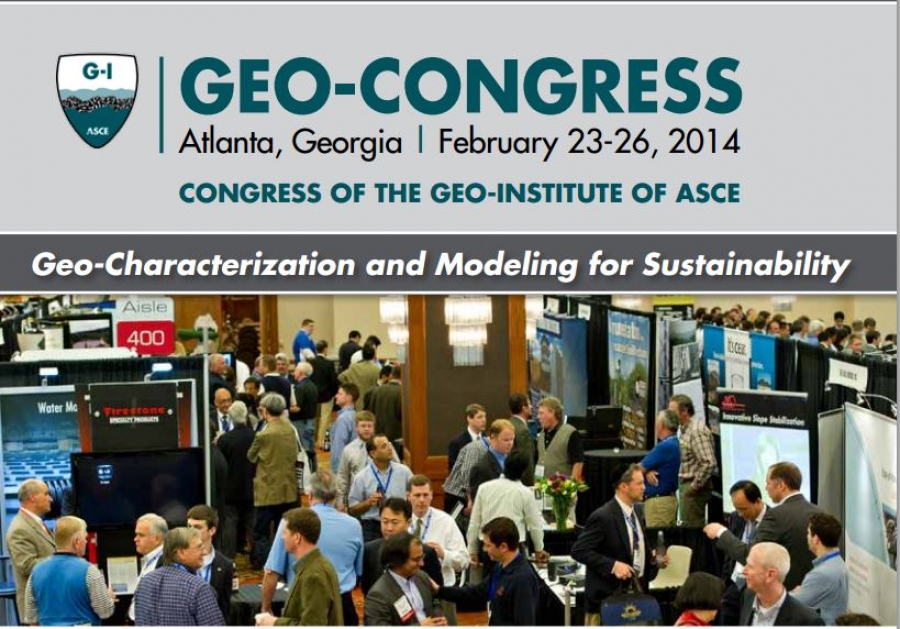
Read on to learn what speakers focused on, information on the event and its exhibitors! See photos from the GeoWorld group here, and daily highlight videos here!
GeoCongress 2014 has come to an end. This year's theme was "Geo-Characterization and Modeling for Sustainability". The team of Geoengineer.org was there the whole time, as an exhibitor and co-operating organization of ASCE's Geo-Institute. We were at the exhibit hall as well as lectures and technical sections, managing a live coverage through the Geo-Congress Live Coverage hub: geocongress2014.geoengineer.org. The Live Coverage hub was especially designed for the event and was constantly updated with posts, technical content, photos, videos and comments from the exhibition hall and technical sessions until the end of the event on the 26th of February!
The conference kicked off on Sunday 23rd of February, with the H. Bolton Seed Medal Lecture. Professor W.D. Liam Finn delivered the Harry Seed lecture on "Developments in the Assessment of Liquefaction Potential and its Consequences", opening his presentation by saying: "I won the bronze medal. Keeping Olympics spirit going even after it's over". He referred to the very beginning when Prof. Harry Seed, with his two students Ken Lee and Ed Idriss and based on two earthquakes set the foundations in the assessment of liquefaction potential. He also pointed out that "most case histories of piles from Japan on liquefiable ground involve piles not designed for lateral loads", while at the end of his presentation, he presented an example of a structural and a geotechnical engineer working together to design shallow foundations using tie beams and steel columns for a school on liquefiable ground. The day closed with a warm welcome reception at the exhibition hall.
Monday, February 24, started with keynote speakers William A. Wallace and Mark Cassidy in one room and Roman D. Hryciw and Sibel Pamukcu in the other. Prof. Mark Cassidy referred to the geotechnical challenges in the offshore oil and gas extraction. Prof. Roman Hryciw, talking about innovations in optical geo-characterization, stated: Sedimaging is a device that with one photo gives you the entire grain size distribution with thousands of points. It is faster, cleaner and better than sieve analysis! Later that day, geo-legend Prof. Roy E. Olson was there, to sign the new special ASCE publication "Principles and Practices in Geotechnical Engineering" in honor of his long contribution to the geoprofession. Soon afterwards, in the Honorary Symposium session the outstanding representatives of the academic and professional fileds Russell A. Green, Kenneth H. Stokoe, II, David E. Daniel, Gholamreza Mesri, Craig H. Benson, Robert B. Gilbert, Richard D. Woods, J. Erik Loehr, John S. McCartney and Frank Rausche gave lectures on the topic of Principles and Practices in Geotechnical Engineering. Panel discussion sessions of the day included topics on the Value of Sustainability in Engineering, Geotechnics of Soil Erosion and Liquefaction Triggering Evaluation Methods. Among the day's highlights the Geo-Wall competition took place, lasting for about four hours. GeoWall student competition results: 3rd place RPI, 2nd place Cal Poly Pomona, 1st place Cal State Fullerton. For photos from the event please refer to the special GeoWorld group! The day ended with the Ping-Pong tournament hosted by Younger Members of the Geo-Institute.
Tuesday, February 25, started with keynote speakers Sandra L. Houston and Youssef M. A. Hashash in one room and Dennis R. Hiltunen and Rodrigo Salgado in the other. Prof. Hashash talked about hurricane Sandy and characteristically stated that: "Hurricane Sandy exposed the vulnerability and fragility of our urban centers to extreme weather. As a society we need to adapt to a new normal. Past performance experience is not sufficient". Prof. Salgado discussed the Mechanics of Cone Penetration and its Application to CPT Interpretation and presented a very interesting animation of a cone penetrating soil to state that: "CPT is a simple test by hides complexities". Later that day, Geo-Institute's greatest honor, the Terzaghi Lecture, was delivered this year by Prof. Carlos Santamarina from Georgia Tech on the topic of "Energy Geotechnology: Enabling New Insights Into Soil Behavior". Santamarina quotes include: "Almost all life quality indicators are correlated with power consumption!" and "We design civil infrastructure for 25-30 yrs. For energy we need to focus on time scales of thousands of years" Also Santamarina quoted Mitchell in that: "we must forget that soil grains are inert". Definitely a tremendous experience for all attendees and an absolute must-see online! Panel discussion sessions of the day included topics on using Laboratory, In situ, and Geophysical Methods in Geo-charactirization, Principles of Engineering Geology that Geotechnical Engineers Need, as well as Experiences with Geotechnical Baseline Reports for Foundation and Earthwork Projects.
On Wednesday February 26, poster sessions were completed and followed by a networking break. Team from Oregon State won the first place in the Geoprediction contest, while the 2014 Hero Award of the Geo-Institute went to Fred H. Kulhawy from Cornell University. The conference ended with Prof. Hashash from UIUC delivering the distinguished Ralph B. Peck Medal Lecture on "Innovations in Modeling and Monitoring Technologies for Response of Deep Urban Excavations". Panel discussion sessions of the day included topics on Modeling and Characterization of Solid-Fluid Material Transitions in Soil Mechanics.
Technical sessions were ongoing with topics on Geo-Characterization, Numerical and Resilience Modeling, Numerical and Resilience Modeling Sustainable Design, Visualization and Communication.For more information on the presentations you can visit the Live Coverage Hub.
We very much enjoyed this year's Geo-Congress 2014 and look forward to the IFCEE 2015 (International Foundations Congress and Equipment EXPO), co-organized by ADSC (The International Association of Foundation Drilling), DFI (Deep Foundations Institute), G-I of ASCE (Geo-Institute of the American Society of Civil Engineers) and PDCA (Pile Driving Contractors Association) in San Antonio Texas. If you also attended the conference make sure to comment on this article and share your take outs with the Geoengineer.org community!
Nearby News
Want to read more like this story?

Geo-Congress 2014 in Atlanta, live coverage from Geoengineer.org!
Feb, 21, 2014 | NewsASCE's Geo-Institute, Geoengineer.org and GeoWorld are happy to announce the live online coverage of...

Key takeaways from Geo-Congress 2013 (3-7 March 2013) in San Diego, CA
Mar, 03, 2013 | NewsRead on to learn what speakers focused on, information on the event and its exhibitors, photos and v...

ASCE Geo-Institute' s Geo-Congress 2014 is approaching!
Dec, 09, 2013 | NewsThe "Geo-Congress 2014: Geo-Characterization and Modeling for Sustainability" will take place in Atl...

Live Coverage of GeoCongress 2014 in Atlanta from Geoengineer.org!
Feb, 23, 2014 | NewsThe team of Geoengineer.org is pleased to announce we will be not only exhibiting and participating...

Video: Watch the 2014 Terzaghi Lecture!
Jun, 10, 2014 | NewsWatch the 2014 Terzaghi Lecture, entitled "Energy Geotechnology: Enabling New Insights Into Soil Beh...

Register today for Geo-Congress 2013 in San Diego, CA, March 3-6!
Mar, 03, 2013 | NewsASCE’s Geo-Institute, the organizer of Geo-Congress 2013, is guaranteeing a cost-effective program...

Videos on the latest Seed and Terzaghi Lectures from the Geo-Institute of ASCE
Oct, 22, 2013 | NewsMany lectures are available on the Geo-Institute’s YouTube channel including the latest Seed and Ter...

LIVE COVERAGE OF GEOCONGRESS 2013 IN SAN DIEGO FROM THE TEAM OF GEOENGINEER.ORG!
Mar, 01, 2013 | News{module [532]} Geoengineer.org and GeoWorld are happy to announce the live coverage of GeoCongress...

Award lectures from Charlotte Geo-Congress 2022
Apr, 07, 2022 | NewsThe following special lectures were given at the context of Geo-Congress 2022 (Charlotte, North Car...
On This Day
August 22nd 1902
READ MORE
Related Video

Trending

Lake Chippewa’s floating island that has to be boat-pushed every year
How to Model Piles in PLAXIS

3 Types of Retaining Walls and Revetments


How Do Dams Trigger Earthquakes?
Asbestos remains a deadly infrastructure risk across the UK
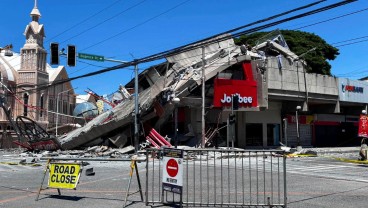
Major earthquake in southern Philippines causes deaths and widespread damage