

CHANCE engineers Jason Herron and Joseph Brown will present on the Installation and Efficiency of Common Helical Couplings at the DFI 44th Annual Conference in Chicago on Thursday, October 17.
ABSTRACT:
The common couplings for joining sections of helical piles with an outside diameter of 6.625 inches and 8.625 inches are square on square, flange to flange, external pipe sleeve, internal pipe sleeve, and welded joint. Each coupling type has advantages and disadvantages in efficiency, capacity, installation, and economics of the installed pile. All these coupling types have been used in the helical pile market in North America for various applications and designs. Many of these applications require on-site testing, but test records are not typically shared with the helical pile industry.
Due to the lack of information available for square on square and flange to flange couplings, testing was done to compare the efficiency of installation, load to deflection response, and torque to capacity ratios of external pipe sleeve, square on square, and flange to flange couplings. Field installations and tension tests were performed in non-cohesive (sand type) soil near Caseyville, IL and in cohesive (clay type) soil in Centralia, MO.
The data collected during these tests included rotations per foot during installation, installation torque, applied pressure, and deflection. The results of this testing are analyzed and discussed within this paper. The results indicate that the square to square coupling is the most efficient of the designs tested, but this conclusion cannot be fully justified without further testing due to the variability in the data gathered and the small number of piles tested.
Want to read more like this story?
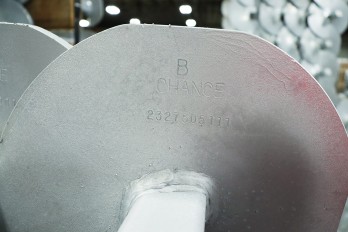
Seven Frequently Asked Questions about Helical Piles
Apr, 29, 2026 | NewsHelical piles are a proven deep foundation solution used across commercial, industrial, utility, and...

High Capacity Helical Piles
Apr, 05, 2021 | NewsWhen it comes to deep foundations and high capacity piles in general, helical piles are often overl...
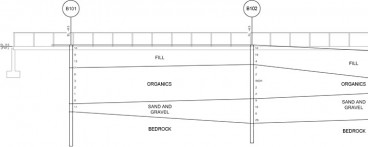
Deep Foundation “Feedback”: Valuable Early Data From The Jobsite
Dec, 20, 2021 | NewsLearn how Geotechnical Engineers use valuable jobsite data to validate their recommendations for de...
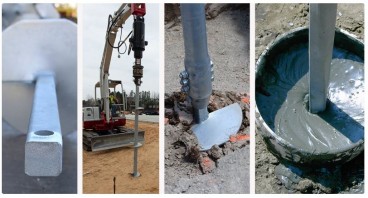
Which Helical Pile Type to Choose & Why: Square, Round, Combo or Displacement
Mar, 21, 2025 | NewsHelical piles are screw anchors that are widely used in applications where unstable soils require e...

The 2 Questions a Helical Pile Engineer Will Ask
Oct, 26, 2022 | NewsThe two questions every helical pile engineer should ask when starting a new project are: What are...

Helical Piles Case Study on Weathered Rock Construction
Jun, 15, 2022 | NewsThis interesting case study features the use of helical piles for a deep foundation on a new constr...

Why you Should Use at Least 2 Methods to Determine Helical Pile Capacity
Nov, 10, 2020 | NewsCHANCE® Foundation Solutions recently wrote a blog post arguing why you should use at least 2 me...

5 Questions about Load Tests on Helical Piles [Answered]
Feb, 09, 2022 | NewsHelical pile installers and designers get this question all the time: “Do I need to do full scale l...

Helical pile solution for dense or rocky soil
Apr, 28, 2023 | NewsThe wear-resistant, offset carbide tip designed to break through even the toughest soil conditions…...
Form
Looking for more information? Fill in the form and we will contact CHANCE Foundation Solutions for you.
On This Day
August 4th 2014
READ MORE
Related Video

Trending

How to Model Piles in PLAXIS

3 Types of Retaining Walls and Revetments


How Do Dams Trigger Earthquakes?

Quick Clay Failure on Norway’s E6 at Levanger
Asbestos remains a deadly infrastructure risk across the UK
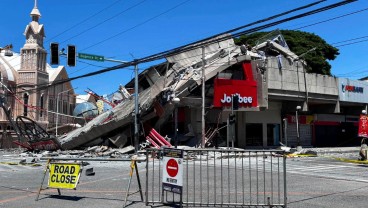
Major earthquake in southern Philippines causes deaths and widespread damage