India’s largest rail TBM begins tunnelling beneath Mumbai
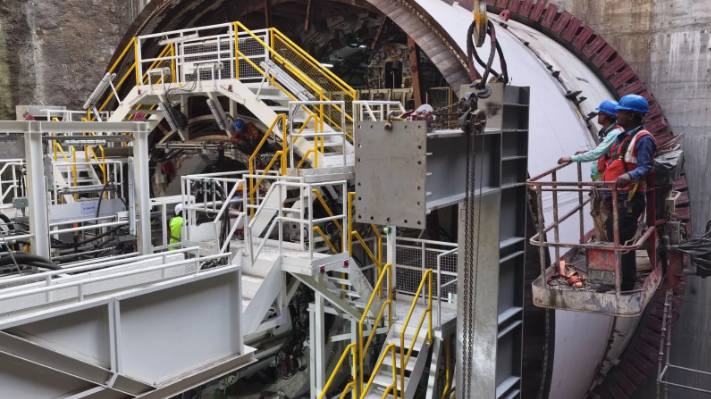
India’s Mumbai-Ahmedabad high-speed rail project has reached a major underground construction milestone, with the country’s largest rail tunnel boring machine beginning excavation from the Vikhroli shaft in Mumbai. The machine will drive a 6 km tunnel section towards Bandra Kurla Complex, forming part of the 21 km underground section of India’s first high-speed rail corridor.
The tunnel is being built as a single large tube designed to accommodate both up and down high-speed rail tracks. Of the 21 km underground section, around 16 km between Sawli in Ghansoli and Bandra Kurla Complex will be excavated using tunnel boring machines, while a further 5 km has already been completed using the New Austrian Tunnelling Method.
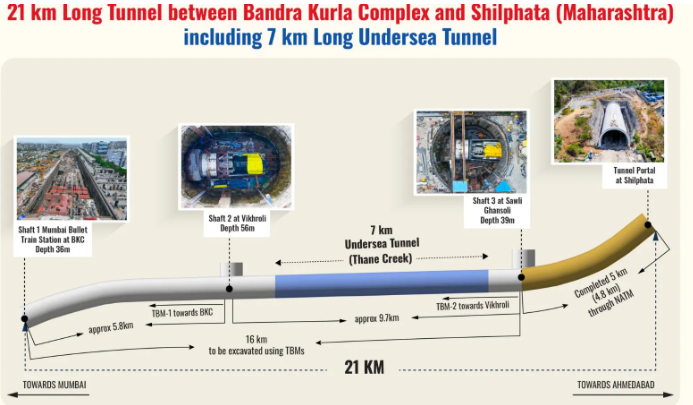
This section is among the most technically demanding parts of the 508 km high-speed rail corridor because it passes beneath one of India’s densest urban environments. The TBM will tunnel below multi-storey buildings, major roads, the Mithi River and other critical infrastructure, where ground movement must be tightly controlled.
The TBM launched from Vikhroli is a Mixshield machine, a slurry-type system suited to large-diameter excavation in mixed ground and high groundwater pressure. It has a 13.6 m diameter cutterhead, weighs about 3,100 tonnes and is approximately 96 m long.
The choice of a Mixshield TBM is important for Mumbai’s ground conditions. In dense urban areas, the tunnel face must remain stable while excavation advances, especially where soils, rock, groundwater and existing foundations may vary over short distances. Slurry pressure helps support the excavation face, reducing the risk of excessive ground loss and surface settlement.
The machine can excavate and install concrete segmental lining rings in sequence, allowing the permanent tunnel lining to be formed immediately behind the cutterhead. This parallel operation improves construction speed and helps maintain tunnel stability during advance.
Because the tunnel passes below sensitive urban infrastructure, real-time monitoring is central to the works. Instruments include surface settlement points, optical displacement sensors, tilt meters, 3D targets, strain gauges and seismographs. These systems allow engineers to track ground movements, building response and construction-induced vibration as excavation progresses.
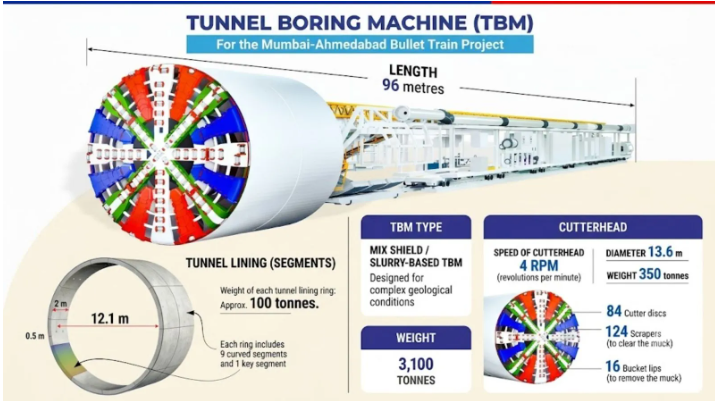
The tunnel is also being designed as a fully waterproof structure. Around 77,000 precast concrete segments are being manufactured to form approximately 7,700 tunnel rings. Each ring consists of nine curved segments and one key segment, with a complete ring weighing about 100 tonnes. The lining system will include double-layer EPDM gaskets and hydrophilic seals to reduce water ingress and improve long-term durability.
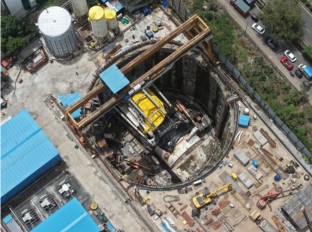
A 56 m deep launch shaft has been constructed at Vikhroli to support the tunnelling operation. The shaft area includes slurry treatment, water treatment, bentonite storage, power supply, backup generators, grouting facilities and other logistics systems required for continuous TBM operation.
The start of TBM excavation is therefore more than a construction milestone. It represents a complex geotechnical operation beneath a dense city, where tunnelling performance, settlement control, groundwater management and structural monitoring must work together. For India’s first high-speed rail corridor, the success of this underground section will be critical to connecting the bullet train directly into Mumbai’s urban core.
Sources: indianexpress.com, psuconnect.in, tribuneindia.com
Want to read more like this story?
Second giant TBM begins work on India’s first undersea rail tunnel
Jul, 19, 2026 | NewsA second large-diameter tunnel boring machine has started excavation on the Mumbai-Ahmedabad High-Sp...

Yangtze River high-speed rail tunnel completed after record underwater TBM drive
Apr, 07, 2026 | NewsChina has reached a major tunnelling milestone with the completion of the underwater section of the...

HS2 launches final giant TBM “Karen” for Euston Tunnel as High-Speed Rail enters final boring phase
Mar, 16, 2026 | NewsHS2 has reached a major tunnelling milestone with the launch of its final tunnel boring machine (TB...
Advanced mixshield TBM tackles chalk and flint beneath the Thames
May, 13, 2026 | NewsConstruction has begun on a major sub-river power tunnel beneath the River Thames as part of Nationa...

China’s TBM rescue beneath the Yangtze
Jan, 12, 2026 | NewsDuring construction of the Jiangyin–Jingjiang Yangtze River Tunnel, a 6.4 km road tunnel beneath th...
Deep beneath London: HS2 completes critical safety cross passages in Northolt tunnel
Apr, 27, 2026 | NewsHS2 has reached a major underground construction milestone with the completion of all 34 cross passa...
India first underwater road and rail tunnel under Brahmaputra
Jun, 15, 2026 | NewsIndia has approved the construction of its first underwater road-cum-rail tunnel beneath the Brahmap...

Underground works begin on major Madrid Metro extension
Mar, 29, 2026 | NewsTunnelling works have commenced for the extension of Metro Line 11 in Madrid, marking a key milesto...

Tunneling
Apr, 24, 2020 | EducationA tunnel is an underground structure which is constructed through the surrounding mass of soil or...
On This Day
August 22nd 1902
READ MORE
Related Video

Trending

Lake Chippewa’s floating island that has to be boat-pushed every year
How to Model Piles in PLAXIS

3 Types of Retaining Walls and Revetments


How Do Dams Trigger Earthquakes?
Emergency ground stabilisation protects rail works near Salford Central