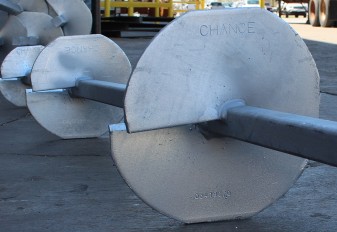
Hubbell's helical pile systems: A foundation solution to swimming pools in difficult soil conditions Sponsored

CHANCE Foundation Solutions, a Hubbell's company, utilized its helical pile systems to support the foundation of swimming pools.
The foundation of a swimming pool can experience sinking due to unstable or poorly compacted soil. Ensuring a pool is constructed on a deep, lasting foundation will protect the owner's investment and save them from costly future repairs. Whether you're a contractor building a backyard pool or an indoor aquatic center, starting on a firm foundation is key for the long-term success of any project, and there is a wide range of variables in the design process.
Traditional deep foundation swimming pool support systems such as timber piling, concrete piling and drilled concrete piers are not always effective and can be replaced by helical piles and anchors that provide an exceptional pool foundation.
Helical piles can be installed with small equipment that allows greater flexibility with mobilization in and around existing structures with restricted access, whereas traditional methods have significant mobilization cost, site access challenges, and site disruption and clean-up.
Two case studies where the CHANCE helical pile systems has been utilized are presented below.
YMCA Pool Foundations in Pensacola, Florida
The project included a new facility containing an indoor, accessible aquatic center with two pools. The contractors had to overcome a tight schedule. Moreover, a roof system should be installed as soon as possible so that water does not affect the advancement of further works. Thus, the deep foundations for the pools would need to be installed after the roof was complete.
Furthermore, the endeavor faced a tight production timeline with complex soil counts. The site had a soft layer of sand for the first 10-15 ft. and below that was approximately 20 ft. of extremely dense clay.
Due to the tight schedule and the soil conditions, the solution came from the CHANCE® Helical Pulldown micropiles (HPM). The CHANCE HPM is a technologically advanced, cost effective, high capacity deep foundation system. The HPM is a true composite pile that combines both skin friction and end bearing components to provide much higher capacities than provided by standard helical piles.
The pools were supported by a total of 36 Helical Pulldown Micropiles. Working loads per pile ranged from 65 to 100 kips in compression and 10 to 65 kips in tension. All piles were installed to meet the design loads with a minimum factor of safety of 2. Pile installation was completed in one 40-hour workweek.
The contractor estimates the time saved to be six to eight weeks on production and prevented project delays due to weather. The pile installation was the third Helical Pulldown Micropile project that the installers completed, and they found the piles easy to work with.
For more information on how to build a lasting pool foundation with CHANCE Helical Pulldown micropiles click here.
The Backyard Pool project in Allen, Texas
This project included the construction of a backyard pool in an area with expansive clay soils.
This type of soil is vulnerable to large volume changes associated with alterations in its water content. As a result, it may experience uplift that would result in cracks in the pool. Therefore, the foundations in expansive clays need to withstand both compression and tension loads.
Concrete piles are not effective in these types of soils as the helical foundation solutions tend to move. Movement in a pile will lead to cracks and eventual leaks in the pool.
Another problem that arose was that the pool construction site was located in the backyard of a residence that did not allow for access of large construction equipment.
To address the aforementioned issues, the CHANCE helical pile system was selected due to its proven performance and versatility. In particular, the soil strata has very dense material but the introduction of lateral loads at the surface posed a unique problem and, thus, the CHANCE combo pile was chosen.
Twenty-five piles were installed using standard CHANCE SS5 leads that transitioned to RS2875.203 extensions to depths of 18 to 22 feet.
The piles were installed around the perimeter of the pool on 10′ centers and were installed to the required ultimate capacity of 25,000 lbs. Once installed, rebar was passed through the existing bolt hole at the top of the extension and tied into the pool’s rebar cage. The ability to link the pool rebar cage to the helical piers is the solution to overcome the compression and tension forces caused by cyclical moisture content in the soils.
Image Gallery

Want to read more like this story?

High Capacity Grouted Piles Project
Sep, 05, 2022 | NewsA YMCA building and pool foundation were designed on grouted micropiles due to a layer of organic c...

High Capacity Helical Piles
Apr, 05, 2021 | NewsWhen it comes to deep foundations and high capacity piles in general, helical piles are often overl...

Helical Pile vs Driven Concrete Pile Foundation: Golf Coast New Construction Residence Project
Mar, 22, 2023 | NewsSituated on the sandy shores of the Gulf Coast, this new construction residence required a foundati...
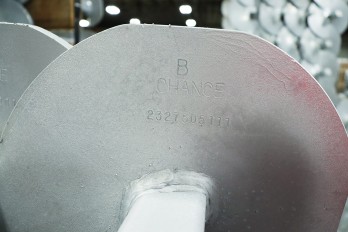
Seven Frequently Asked Questions about Helical Piles
Apr, 29, 2026 | NewsHelical piles are a proven deep foundation solution used across commercial, industrial, utility, and...

Helical Piles Case Study on Weathered Rock Construction
Jun, 15, 2022 | NewsThis interesting case study features the use of helical piles for a deep foundation on a new constr...

The 2 Questions a Helical Pile Engineer Will Ask
Oct, 26, 2022 | NewsThe two questions every helical pile engineer should ask when starting a new project are: What are...

Foundation Stabilization on a Alabama Residence after Hurricane Sally Case Study by Hubbell
Aug, 23, 2021 | NewsThe devastating effects of Hurricane Sally are still felt in Baldwin County, Alabama, as the signs...

Comparison of Residential Foundation Repair / Remediation options
May, 20, 2022 | NewsCHANCE Foundation Solutions Engineer Shawn Downey compiled a comparison of foundation repair option...

Temporary Bridge Foundation Helical Piles Project
Jul, 09, 2024 | NewsLimited access, weight restrictions, environmentally sensitive area, flood plain with river liable...
Form
Looking for more information? Fill in the form and we will contact CHANCE Foundation Solutions for you.
On This Day
August 22nd 1891
READ MORE
Related Video

Trending

Block caving: A new mining method arises

Categories of isolated foundation footings
Maharashtra's longest road tunnel to be completed soon

Carnian Pluvial Episode: That time when it rained for 1-2 million years

China's Three Gorges Dam under pressure: Flood hazard downstream
Tailrace tunnel breakthrough advances Australia’s largest renewable project
A Legacy of Leadership, Mentorship & Service: Gary L. Seider P.E.