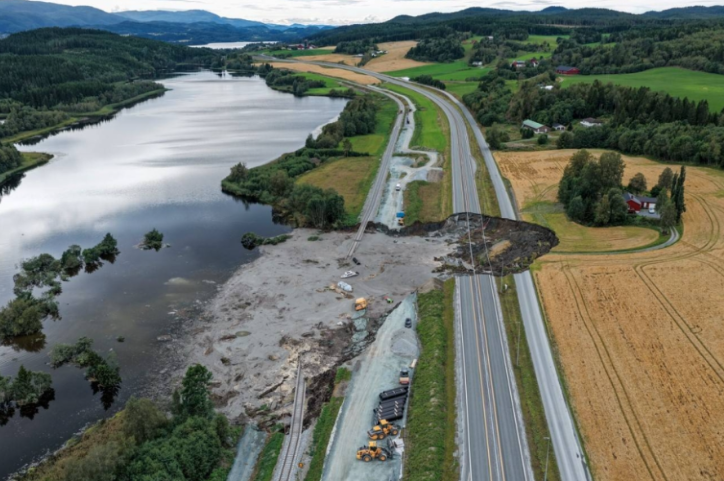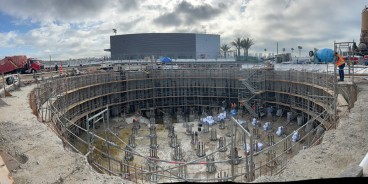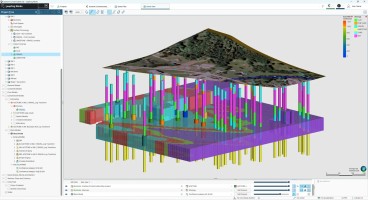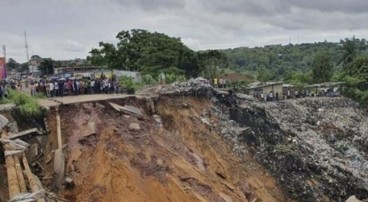
Landslide view and extent at Nesvatnet near Levanger. Source: Geoengineer (image by Ole Martin Wold/NTB Scanpix via AP)
A fatal landslide that occurred during a railway expansion project in Levanger, Norway, has been linked to ground stabilization works involving deep cement mixing (DCM), according to a detailed engineering investigation. The incident, which took place on August 30, 2025, resulted in the death of a construction worker and caused extensive damage to both railway and highway infrastructure.
The landslide displaced approximately 72,000 cubic yards of material, destroying more than 550 feet of railway track and 320 feet of the adjacent E6 highway. The failure occurred shortly after the installation of a cement-mixed column, with workers reporting unusual subsurface noises moments before the ground gave way. Despite attempts to evacuate, one worker was caught in the collapse. His body was recovered nearly two weeks later.
The project involved the construction of a new passing loop, along with upgrades to crossings and drainage structures. Due to the presence of quick clay, a highly sensitive and potentially unstable soil type, ground improvement was required using deep cement mixing techniques.
The investigation found that the DCM process itself played a critical role in triggering the failure. The method involves injecting cement slurry into the ground and mechanically mixing it with in-situ soils to form stabilizing columns. However, in this case, the mixing process temporarily weakened the quick clay before the cement could gain strength.
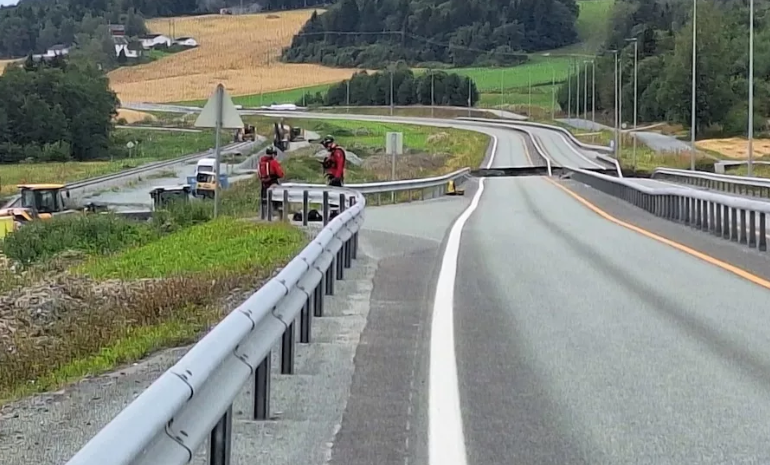
Roadway deformation and subsidence following the Levanger landslide, where ground failure caused collapse of the adjacent highway due to instability in underlying quick clay deposits. Source: ENR (image by Bane NOR)
At the same time, the injection of slurry led to a rapid increase in pore water pressure within an underlying permeable layer of sand and silt located approximately 6 metres below the surface. This layer had been identified during preliminary investigations but was not fully mapped or instrumented for monitoring. The rapid pressure buildup caused water to be displaced faster than the clay could drain, significantly reducing the effective stress and shear strength of the soil mass.
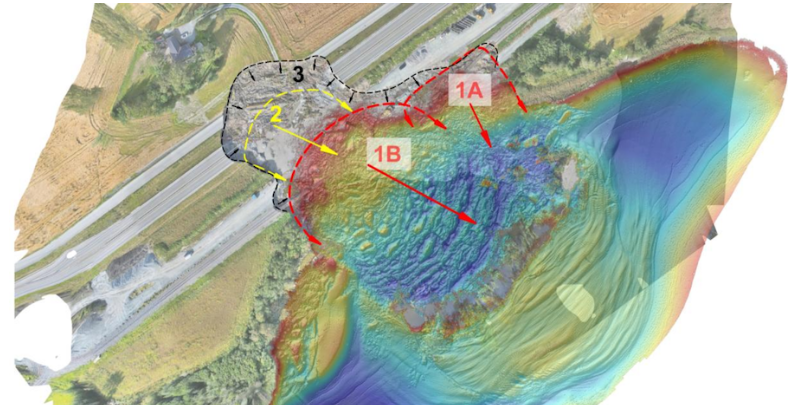
The initial failure occurred directly beneath the rig, where the clay mass began to slide toward a nearby lake. This triggered a progressive landslide, with subsequent failures propagating upslope and laterally. The loss of support beneath the highway led to its collapse, further increasing the volume and momentum of the sliding mass.
From a geotechnical perspective, the incident highlights the sensitivity of quick clay deposits to disturbance and loading changes. Such soils can undergo rapid strength loss when remoulded or subjected to excess pore pressure, leading to large-scale failures even under relatively small triggers.
The investigation concluded that more comprehensive site characterization and monitoring could have identified the risk earlier. Specifically, the permeable sand and silt layer should have been fully delineated, and pore pressure instrumentation should have been installed within this layer, not just within the clay. Real-time monitoring of pore pressure changes during DCM operations may have provided early warning signs of instability.
Plan view of the Levanger landslide showing the initial failure zone (1A), subsequent progressive slide area (1B), and retrogressive failure extending upslope, illustrating the sequence of quick clay instability and mass movement toward the adjacent water body. Source: ENR (image by Dr techn Olav Olsen AS)
Recommendations from the report include mandatory mapping of all permeable layers within quick clay environments, expanded instrumentation strategies, and enhanced monitoring protocols during ground improvement works. These measures are intended to reduce the risk of similar failures in future projects involving sensitive soils.
The incident is also under review by Norwegian authorities, including labor and safety regulators. The findings are expected to influence industry practices, particularly in regions where quick clay is present, such as Scandinavia and parts of North America.
Geoengineer.org uses third party cookies to improve our website and your experience when using it. To find out more about the cookies we use and how to delete them visit our Cookies page. Allow cookies