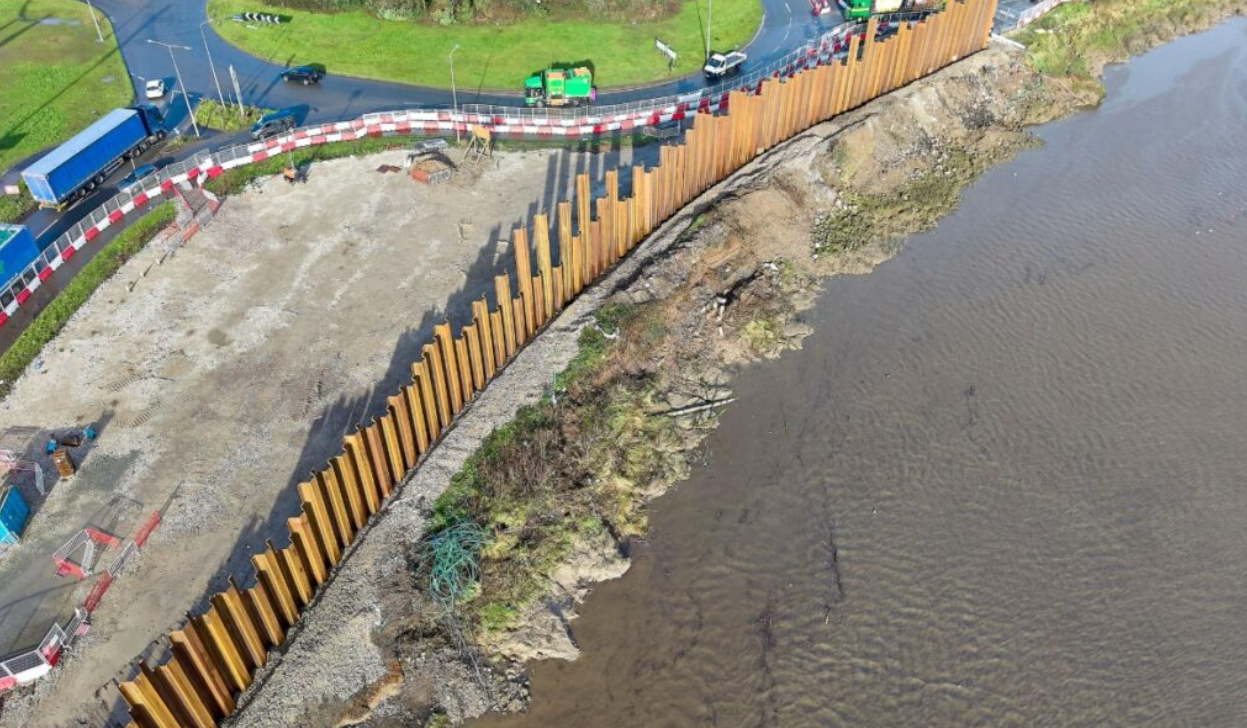
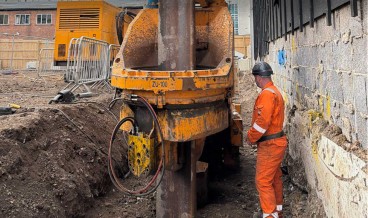
Sheet pile wall installation extending into underlying mudstone to stabilize the riverbank. Source: Dredging today (image by Cardiff Council)
Construction of the Cardiff Coastal Defence scheme at Rover Way is advancing as part of a £35.2 million project designed to protect critical infrastructure, residential areas, and industrial assets from increasing risks of coastal erosion and flooding. Delivered by Knights Brown for Cardiff Council, with major funding support from the Welsh Government, the scheme responds to growing concerns over rising sea levels and long-term climate change impacts.
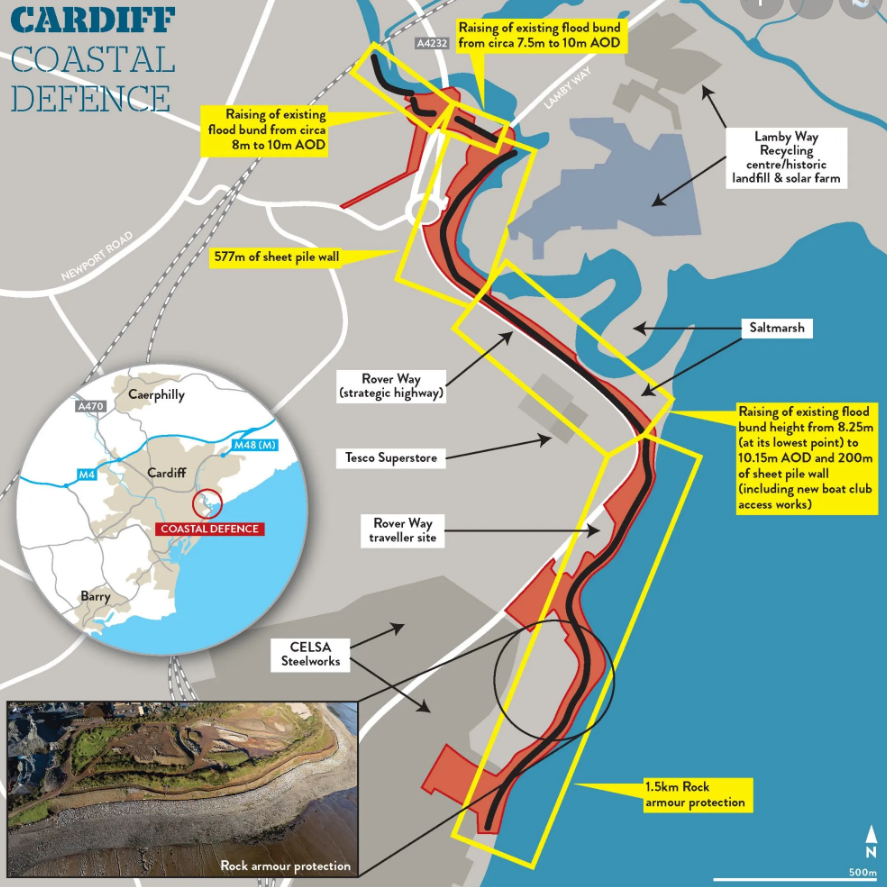
Layout of the Cardiff Coastal Defence scheme at Rover Way, showing the alignment of rock armour protection, raised flood embankments up to 10m AOD, and sheet pile wall sections designed to protect critical infrastructure and mitigate coastal erosion and flooding risks. At the bottom left the rock armour protection is demonstrated. Source: NCE (image by Cardiff Council)
The project is designed to protect more than 1,700 homes, over 100 businesses, and key infrastructure including Rover Way, steelworks facilities, substations, pumping stations, and recycling operations. Modelling has shown that failure of existing defences could allow floodwaters to travel deep into Cardiff, potentially reaching central areas and causing widespread damage. The scheme is therefore designed to withstand a 1-in-200-year flood event, incorporating a 40% climate change allowance in line with national guidance.
Construction began in late 2024 and forms part of a wider programme of coastal risk management investment across Wales. The scheme combines multiple defence systems to address both wave action and long-term sea level rise, reflecting the complexity of coastal processes in the Cardiff Bay area.
The southern section of the project includes approximately 1.5 kilometres of rock armour, constructed using interlocking stones weighing between 1 and 3 tonnes. These are placed over a granular foundation layer, separated by geotextile fabric to prevent material migration and maintain structural integrity under wave loading and tidal forces. Early site investigations identified voids within the existing embankment caused by historical erosion and the presence of industrial by-products such as fused slag. As a result, the design was modified, requiring reprofiling of the shoreline and the placement of engineered fill to stabilize the foundation before installing the rock armour.
Further inland, the scheme incorporates raised flood embankments, with crest levels increased from approximately 8.25 metres to over 10 metres Above Ordnance Datum. These embankments provide protection against rising sea levels, while working in conjunction with the rock armour to prevent erosion at the toe of the slope.
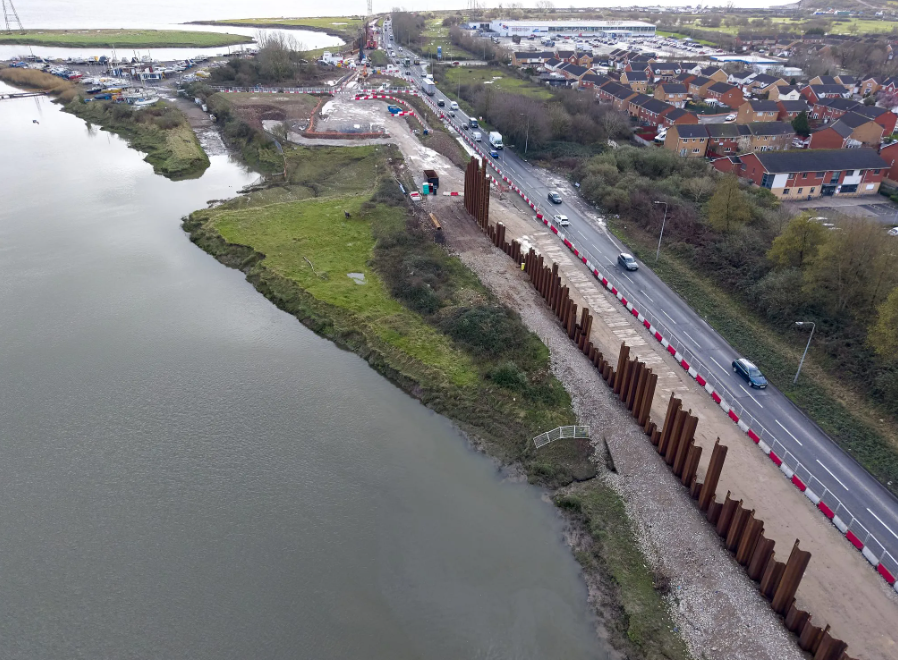
A key structural component of the scheme is the installation of sheet pile walls, with some sections extending up to 19 metres into the ground to reach competent mudstone layers beneath weaker tidal flat deposits. These deeper layers provide the necessary resistance against long-term erosion and lateral loading. However, the presence of soft, unstable ground conditions presented significant geotechnical challenges. Analysis identified a potential large-scale slope failure mechanism within 41 metres of the riverbank, driven by weak deposits up to 12 metres deep.
Sheet pile wall installation extending into underlying mudstone to stabilize the riverbank. Source: NCE (image by Cardiff Council)
To mitigate this risk, construction methodologies were adapted to reduce loading on the slope during installation. Piling equipment was restricted to operate behind previously installed sheet piles to limit ground disturbance. In some areas, alternative solutions such as deep soil mixing are being considered to improve ground strength by forming cement-stabilised columns within the weak deposits.
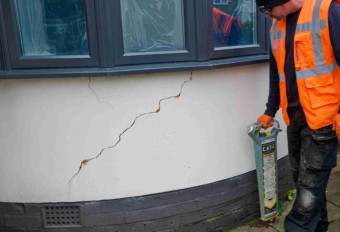
The project also required careful coordination with existing underground utilities, including deep electrical cables and wastewater outfalls. Protective measures such as load transfer slabs were implemented where necessary to prevent damage during construction.
Additional constraints, including environmental restrictions, tidal working windows, and road access limitations, have further influenced the construction approach. In certain sections, press-in piling techniques are being used to allow works to proceed while maintaining partial traffic flow.
The Cardiff Coastal Defence scheme demonstrates the integration of geotechnical engineering, coastal processes, and adaptive construction methods to address increasingly complex climate-driven challenges. Once completed, the project will provide long-term protection to critical assets while enhancing the resilience of Cardiff’s coastal infrastructure.
Geoengineer.org uses third party cookies to improve our website and your experience when using it. To find out more about the cookies we use and how to delete them visit our Cookies page. Allow cookies