Importing pore-water pressure results from SEEP3D into a two-dimensional SLOPE/W analysis Sponsored

This example replicates the “Rapid drawdown” examples illustrated in SEEP/W and SIGMA/W. The purpose of this example is to demonstrate the steps required to conduct a stability analysis using the pore-water pressure results from a SEEP3D analysis. For further information on the background of rapid drawdown scenarios, please see the SEEP/W or SIGMA/W examples. The stability results obtained using the three-dimensional (3D) pore-water pressures are compared to those from the original two-dimensional (2D) analyses.
Numerical Simulation
The problem configuration for the 2D SEEP/W analysis is shown in Figure 1. The embankment has a height of 10 m with 2:1 side slopes and sits on 10 m of foundation soil. The reservoir depth is 9 m. The downstream toe has a granular under-drain which keeps the water table at the same elevation as the downstream ground surface for a distance of 5 m under the embankment toe. The under-drain is represented with a zero pressure head boundary condition.
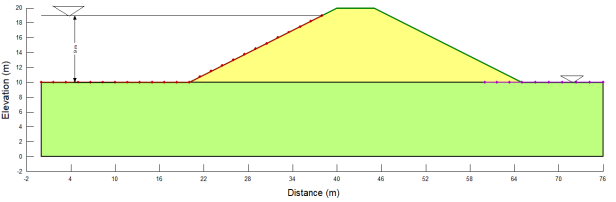
For the purposes of this illustrative example, the embankment and foundation soils are defined to have the same material properties. The saturated hydraulic conductivity is 0.1 m/day, with a compressibility of 0.0002 /kPa. In SLOPE/W, the Mohr-Coulomb material model is used, with a unit weight of 20 kN/m3, cohesion of 5 kPa, and Phi of 30⁰.
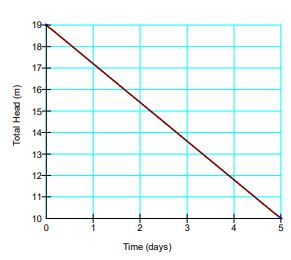
A steady-state seepage analysis defines the initial conditions, where the reservoir level is set to a total head of 19 m. A child transient seepage analysis simulates the falling reservoir level over a 5 day duration. The time-dependent total head boundary condition used to simulate drawdown is shown in Figure 2. To monitor the pore-water pressure response of the embankment following the reservoir drawdown, the transient analysis duration is set to 30 days.
The 2D stability analysis is created by adding a SLOPE/W analysis as the child of the transient SEEP/W analysis. The pore-water pressure conditions for the stability analysis are taken from all time steps in the parent SEEP/W analysis. The entry-exit slip surface is defined in the right to left direction to determine the critical Factor of Safety of the upstream slope as the reservoir drains and the pore-water pressures in the embankment change.
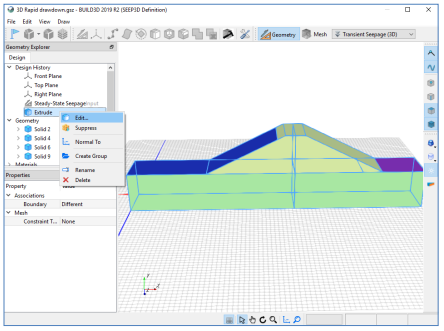
After defining the 2D analyses, a 3D geometry is added to the project file with two SEEP3D analyses associated with this geometry. These SEEP3D analyses have the same configuration as the 2D seepage analyses, such that one is the steady-state, parent analysis and the other is a transient child analysis with a duration of 30 days. The 3D geometry is created by importing the 2D steady-state seepage analysis into BUILD3D. This automatically creates a 1 m extrusion of the two-dimensional cross-section. To extend the extrusion to 10 m, the Extrude item in the Design History list has been edited (Figure 3) and the extrusion slice has been set to 10 m.
In BUILD3D, the section tool is used to generate a 2D cross-section, which yields the 3D results along that section for use in 2D analyses. In the Section command, a vertical XY plane is defined by setting the Direction X,Y,Z values to {0,0,1}, with an offset of 5 m so that the section runs through the middle of the 3D geometry. The Origin X,Y,Z coordinates are set to {0m, 0m, 0m} to ensure that the 2D cross-section will align with the X,Y origin of {0m ,0m} in the SLOPE/W analysis (Figure 4).
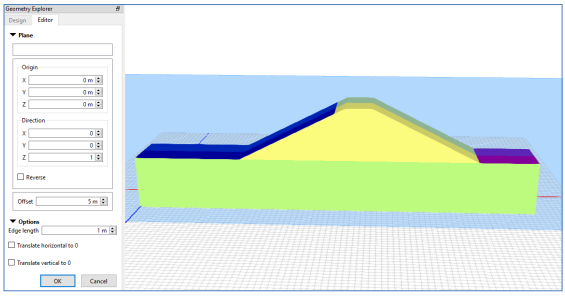
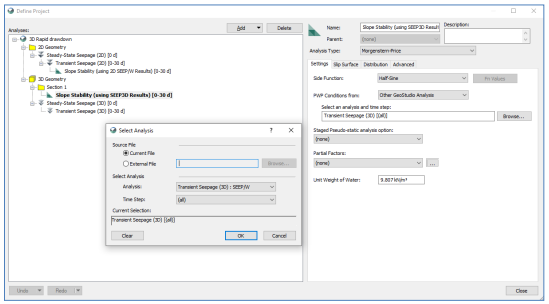
Once created, the section is listed in the Geometry Sections tree of BUILD3D. Selecting the new section and using the Generate command produces a 2D child geometry under the 3D parent geometry. A SLOPE/W analysis can now be added to the 2D geometry section, to simulate the influence of the 3D pore-water pressure response on stability. This SLOPE/W analysis has the same properties as the other SLOPE/W analysis in the project file, except the pore-water pressures are defined from the 3D transient seepage analysis using the “Other GeoStudio Analysis” option in the dropdown menu (Figure 5).
Results and Discussion
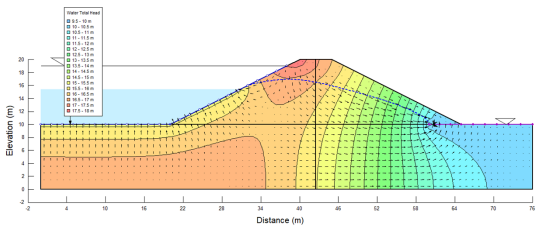
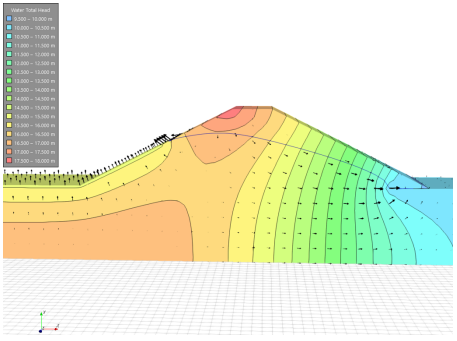
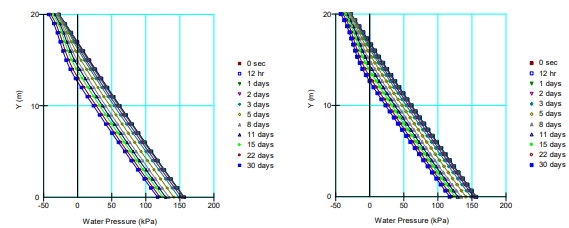
Figures 6 and 7 show the dissipation of excess pore-water pressures 2 days after the start of drawdown in the 2D and 3D transient seepage analyses, respectively. At this time step, flow in both analyses occurs towards the upstream embankment face into the remaining reservoir and in the downstream direction towards the under-drain. The pore-water pressure responses along the center of the embankment in each transient analysis are shown in Figure 8. Similar porewater pressure responses are seen in both the 2D and 3D analyses, as expected.
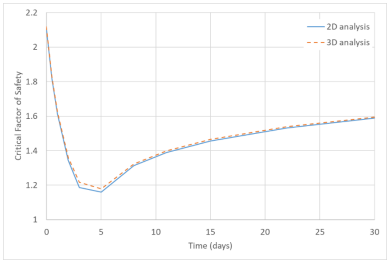
The critical Factor of Safety over the modeled duration never falls below 1.0 (Figure 9). Overall, the SLOPE/W analyses produce similar results; however, there is a small difference in the calculated Factor of Safety around days 4 and 5. This is attributed to the coarser mesh that is applied in SLOPE/W when importing pore-water pressure results from a SEEP3D analysis.
Summary and Conclusions
This example illustrates the procedure for importing pore-water pressure results from SEEP3D into a two-dimensional SLOPE/W analysis. Comparison of the simulated pore-water pressures and subsequent factor of safety over time, show that the 2D and 3D seepage analyses produce similar results.
Sources: GeoStudio - SEEP3D - 3D Rapid Drawdown - Information [PDF], GeoStudio - SEEP3D - 3D Rapid Drawdown - Project [gsz]
Want to read more like this story?

Pore-Water Pressure Definition for a Levee Stability Analysis
Feb, 24, 2026 | NewsThis example explores the effect of a flood event on the stability of a levee underlain by a confin...

2D or 3D LE? That is the Question - Yeager Airport Case Study
Jun, 02, 2021 | NewsWhen is 2D slope stability analysis sufficient and when should 3D analysis be used in conjunction w...

midas GTS NX
Dec, 15, 2022 | Software
Why Run PLAXIS 3D Analysis?
Jun, 07, 2021 | NewsMost geotechnical engineers use FEA software packages for their geotechnical design. It is especial...

Rocscience | Does 3D Slope Stability Analysis Always Produce Higher Factors of Safety than 2D?
Jul, 13, 2022 | NewsBy Reginald Hammah and Frema Awuku-Asabere A lot has been written about 3D slope stability analysis...

3D Slope Stability Analysis of an Open Pit Mine in Minas Gerais, Brazil
Jul, 08, 2022 | NewsBy Thiago Bretas and Felipe Vilela, BVP Engenharia. Two-dimensional (2D) limit equilibrium analysis...

Using GeoStudio to conduct 3D numerical analysis of groundwater seepage and stability at the Ripley Landslide site
Jul, 30, 2024 | NewsLandslides come with significant potential for loss of life and damage to integral infrastructur...

Rocscience | On the comparison of 2D and 3D stability analyses of an anisotropic slope
Jun, 27, 2022 | NewsThe Adoption of 3D Limit Equilibrium Method 2D limit equilibrium analysis is a powerful tool for pr...
Rapid Drawdown in Dam and Levee Design: A Hydrogeologic Perspective in Slide2
Mar, 23, 2026 | NewsWhat happens to a dam or levee when the reservoir that once supported it drops rapidly? From th...
Form
Looking for more information? Fill in the form and we will contact Seequent, The Bentley Subsurface Company for you.
On This Day
August 21st 1883
READ MORE
Related Video

Trending

Quick Clay Failure on Norway’s E6 at Levanger

Keller North America announces recent leadership changes
Fulgurite: A rare phenomenon

Life after gINT - Rethinking geotechnical data management for a new era
Stop Guessing, Start Designing: Introducing Support Designer in Slide2

Development program prepares new engineers for success