
Tunnel Series 3: NATM Tunnel Design
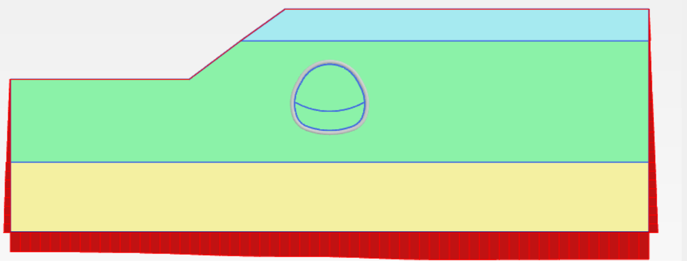
In the NATM method, the tunnel is excavated out in sections over a predetermined length. As a result, the tunnel is built in phases. The NATM method's stability depends in part on the fact that, if permitted to slightly deform, the ground can provide some of its own support. The NATM has frequently been referred to as a method where you can design the tunnel as you proceed, providing an optimized support based on observed ground conditions. However, it is actually an approach based on observed convergence and divergence in the lining as well as current rock conditions.
With PLAXIS geotechnical analysis software, the prediction of ground movement during tunnelling can be efficiently captured. PLAXIS considers the nonlinear interaction between the tunnel and the surrounding soils, as well as the elastoplastic behavior and the complexity of the construction stages.
Register for free to Tunnel Series 3 webinar
Attend this webinar to learn about:
- Modelling of NATM tunnels and incorporation of construction sequence in PLAXIS
- Analysis of settlement of surrounding soil
- Assessment of impact of tunneling on adjacent structures
Want to read more like this?

Bentley Webinar | Modeling With Tunnel Designer in PLAXIS 2D & 3D
Mar, 21, 2023 | EventTunnels are created to make it easier to navigate through challenging topographical and geological...

Bentley Webinar | Safe and Fast Tunnel Analysis in Urban Environment with PLAXIS 2D/3D
Sep, 15, 2023 | EventThousands of years ago, the earliest tunnels emerged as connectors between various ancient structur...

Bentley Webinar: Conquer tunnel excavation modeling with PLAXIS 3D finite element solutions
Feb, 19, 2021 | EventManaging the design and analysis of tunneling requires comprehensive and intuitive tools that will...

Tunneling
Apr, 24, 2020 | EducationA tunnel is an underground structure which is constructed through the surrounding mass of soil or...

Bentley Webinar | Advanced Geotechnical Analysis: Stacked Tunnel Simulation with PLAXIS
Aug, 07, 2024 | EventJoin us for a comprehensive webinar that delves into the case study of twin bored tunnels, strategi...

Bentley Webinar: Modelling of tunnels and tunneling (TBM)
Jun, 23, 2020 | EventRegister to upcoming Bentley's free webinar on modelling of tunnels and tunneling. Webinar will be...

Application of the Convergence-Confinement Method in PLAXIS 2D
Jan, 24, 2022 | NewsEstimation of the support required to stabilize a tunnel excavation, especially in the vicinity o...

Engineering Through Rock and Faults: Geotechnical Challenges of the Daliangshan Highway Tunnel
Oct, 19, 2024 | NewsIn an ambitious endeavor, engineers in Sichuan Province, China, are breaking new ground—literally a...
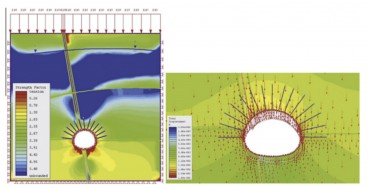
Izmir Metro Tunnel: How Geological Factors Can Impact Your Tunnel Construction
Nov, 14, 2022 | NewsThe population of the world has grown rapidly, and advanced infrastructure like metro tunnels has b...
Form
Looking for more information? Fill in the form and we will contact Bentley for you. Alternatively, you can visit Bentley's website and speak with a Bentley Geotechnical Expert.
On This Day

Related Video

Trending

Plaxis 2D/3D Basic Course – Online Training


Piling & Ground Improvement Conference 2026 (DFI-PFSF)
Reading the Rock: Structurally Controlled Slope Instabilities with DIPS and RocSlope2

Course: Slope Stability Analysis of Open Pit Coal Mine Excavations and Waste Dumps
